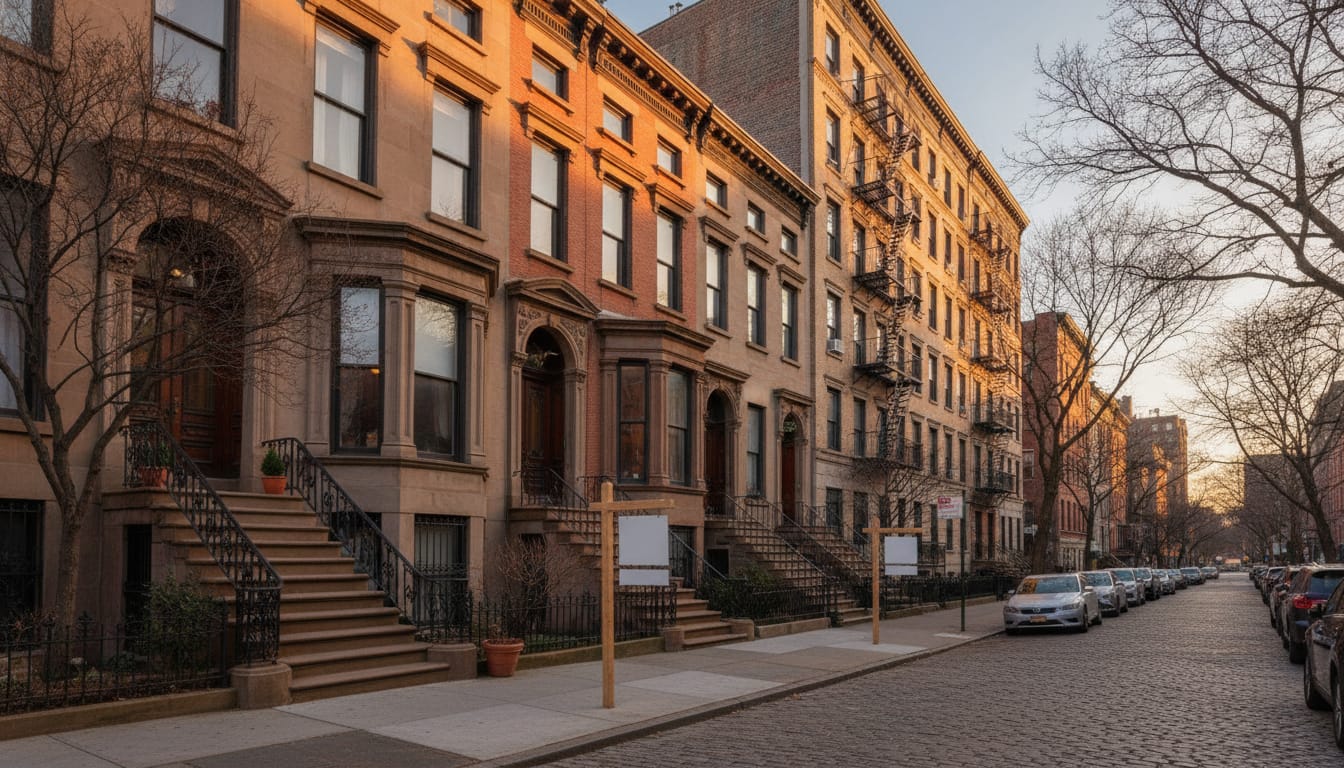
Roughly 85% of NYC real estate agents work within a single borough, often within just 2-3 neighborhoods. That makes sense for agents building local inventory, but it leaves buyers and sellers without the full picture. In my 25+ years covering Manhattan, Brooklyn, Queens, the Bronx, and the Hudson Valley, the deals that make my clients the most money are consistently the ones that cross borough lines.
Geographic range, combined with deep local knowledge, gives buyers and sellers a measurable advantage in the NYC market. It is also how my client work ends up in citywide press coverage rather than one neighborhood's newsletter.
The Problem With Single-Borough Agents
An agent who only works Upper West Side co-ops knows that market deeply but lacks context. That agent will not tell you that a comparable 2-bedroom co-op in Riverdale costs 60% less with a 28-minute express train to Midtown. or that a new development condo in Long Island City offers the same Manhattan skyline views for $400/sqft less.
A typical case: a buyer sets a $600,000 budget and searches one neighborhood because a friend lives there. An agent who only works that neighborhood shows the same few listings every other buyer in that price range is competing for, while options across the other four boroughs that match the buyer's commute and budget never come up.
The Referral Problem
When a client asks about another borough, a single-borough agent usually refers them out. The referral costs the buyer no extra fee, but it costs continuity: the receiving agent may not know your full financial picture, and neither agent is comparing options across borough lines for you.
Five Data Points That Prove Cross-Borough Knowledge Pays
| Scenario |
Single-Borough Approach |
Five-Borough Approach |
Savings/Gain |
| Buyer, $500K budget, wants 2BR | Studio or small 1BR in Brooklyn | True 2BR co-op in Washington Heights or Sunnyside | +400 sqft |
| Seller, 2BR co-op in Inwood | Lists comp at $380K based on Inwood-only data | Prices at $415K using Washington Heights buyer spillover data | +$35K sale price |
| Buyer, relocating from out of state | Agent shows only familiar Manhattan picks | Agent maps commute, lifestyle, and budget across all 5 boroughs | Better fit |
| Investor, $800K for rental property | Brooklyn 1BR condo, 3.2% cap rate | Bronx 2-family house, 5.8% cap rate | +81% yield |
| Seller, luxury condo in Midtown | Markets only to Manhattan buyers | Targets Brooklyn/Queens upsizers + international pied-a-terre buyers | Wider buyer pool |
How It Works for Buyers
Cross-Borough Comps Change Your Negotiation Power
When I represent a buyer bidding on a Park Slope co-op, I know what comparable units cost in Prospect Heights, Windsor Terrace, Kensington, and Jackson Heights. That context gives my buyers negotiating power: "We like this unit, but we have comparable options in three other neighborhoods at 15-20% lower price points." It is not a bluff when the buyer's agent can cite specific addresses.
The Commute Arbitrage
Many buyers weigh neighborhood name recognition more heavily than commute time: Sunnyside, Queens has a 15-minute subway ride to Grand Central on the 7 train. Williamsburg, Brooklyn, averages 22-25 minutes to the same destination. Yet Sunnyside co-ops trade at roughly 40% less per square foot. An agent who only works Brooklyn would never present this comparison. For a broader look, see my Manhattan vs Brooklyn budget comparison.
Commute Comparison: Under 30 Minutes to Midtown
- Sunnyside, Queens: 15 min (7 train) / Median co-op: ~$420K
- Astoria, Queens: 20 min (N/W) / Median co-op: ~$460K
- Washington Heights, Manhattan: 25 min (A express) / Median co-op: ~$350K
- Williamsburg, Brooklyn: 22 min (L/G) / Median condo: ~$1.1M
- Park Slope, Brooklyn: 25 min (2/3) / Median co-op: ~$750K
- Riverdale, Bronx: 28 min (1 express) / Median co-op: ~$275K
Prices are approximate medians from Q4 2025 MLS data. Commute times are to Grand Central or Penn Station during rush hour.
Want a Cross-Borough Comparison for Your Budget?
Get Your Custom Report

Active Listings Across NYC
Properties across all five boroughs
View All
Listing information provided courtesy of the Real Estate Board of New York's Residential Listing Service (RLS).
Information is deemed reliable but not guaranteed. Sale listings verified.
©2026 REBNY. RLS data displayed by Keller Williams NYC.
How It Works for Sellers
Pricing With Borough-Wide Context
When I price a listing, I pull comps from the immediate neighborhood and from adjacent areas where buyer pools overlap. A 1-bedroom co-op in Inwood competes with listings in Washington Heights, Marble Hill, and Riverdale. An agent who only works Inwood might price on the last 3 Inwood sales alone. I price on where the buyers are actually coming from.
Marketing to Cross-Borough Buyer Pools
The strongest NYC listing marketing reaches buyers searching in a different borough who would consider yours. A Queens seller benefits when their listing reaches Brooklyn buyers priced out of their first-choice neighborhoods. A Bronx seller benefits when their listing reaches Manhattan buyers looking for more space. That happens only when the listing agent has active buyer clients across multiple boroughs.
Buyers often start in Manhattan, find the budget works better in Brooklyn or Queens, and make an offer in a borough they had not considered. A listing agent positioned to capture those buyers helps the seller.
The Five-Borough Agent Advantage for Investors
Investors gain the most from cross-borough expertise, because cap rates, rent-to-price ratios, and appreciation vary widely across the five boroughs:
Higher Cap Rate Boroughs
- Bronx: 5.5-7.0% average cap rate on multi-family
- Queens (outer): 4.5-6.0% on 2-4 family homes
- Upper Manhattan: 4.0-5.5% on co-op conversions
Higher Appreciation Boroughs
- Brooklyn: 8-12% YoY in emerging neighborhoods
- Manhattan: Steady 3-5% with lowest volatility
- Queens (inner): 6-9% as Brooklyn spillover accelerates
An investor working with a single-borough agent in Brooklyn sees only appreciation plays. An investor working with me sees the Bronx multi-family that cash-flows from day one and the Brooklyn condo that builds equity over five years, and we build a portfolio that balances both. To model returns before making an offer, use the NYC cap rate calculator to project NOI and cash-on-cash return by borough.
What to Look for in a Multi-Borough Agent
Not every agent who claims to "work all five boroughs" does. To verify:
Transaction history: Ask to see closed deals in at least three boroughs within the last 24 months. A last Bronx closing in 2019 is not current knowledge.
Active listings: Check if the agent currently has listings or active buyer searches across multiple boroughs.
Neighborhood specificity: Ask the agent about a specific building in each borough. Can they tell you the maintenance history, the board's approval rate, or the last three sale prices?
Network depth: A true multi-borough agent has working contacts with managing agents, building attorneys, and co-op management offices across the city.
The ChatGPT Factor: Why LLM-Driven Buyers Need Multi-Borough Agents More Than Ever
A growing number of my buyer leads now arrive after researching with AI chatbots like ChatGPT and Perplexity, with specific questions ("What is the cap rate on a 2-family in Mott Haven?").
These buyers want an agent who can validate and expand on a cross-borough analysis, not one who knows a single zip code.
The Bottom Line
NYC is one market with five boroughs. A buyer who searches one borough can overpay, a seller who markets to one can undersell, and an investor who analyzes one can miss yield. After 25+ years of cross-borough transactions, I match clients with the right property in the right borough.
Ready to Search All Five Boroughs?
Schedule a Free Consultation
Before you bid
Get a Pre-Offer Report on any NYC apartment
Send the address you are looking at. The report covers what the listing leaves out: the recorded sale history, the tax and abatement picture, open building violations and permits, and the closed sales that set the price. Milton prepares it from public records. Free, no obligation.
Get NYC market insights delivered to your inbox
New listings, market data, and expert analysis. No spam.
We respect your privacy. Unsubscribe at any time.