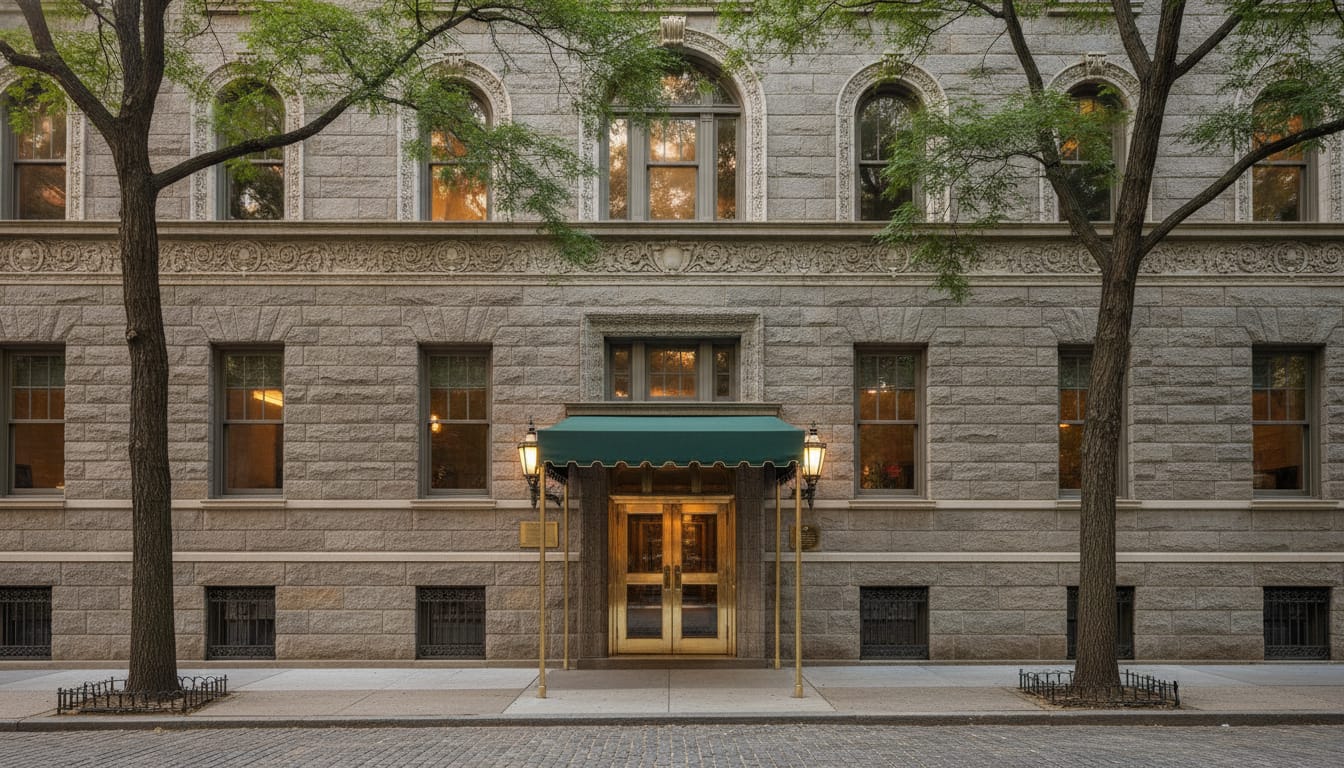
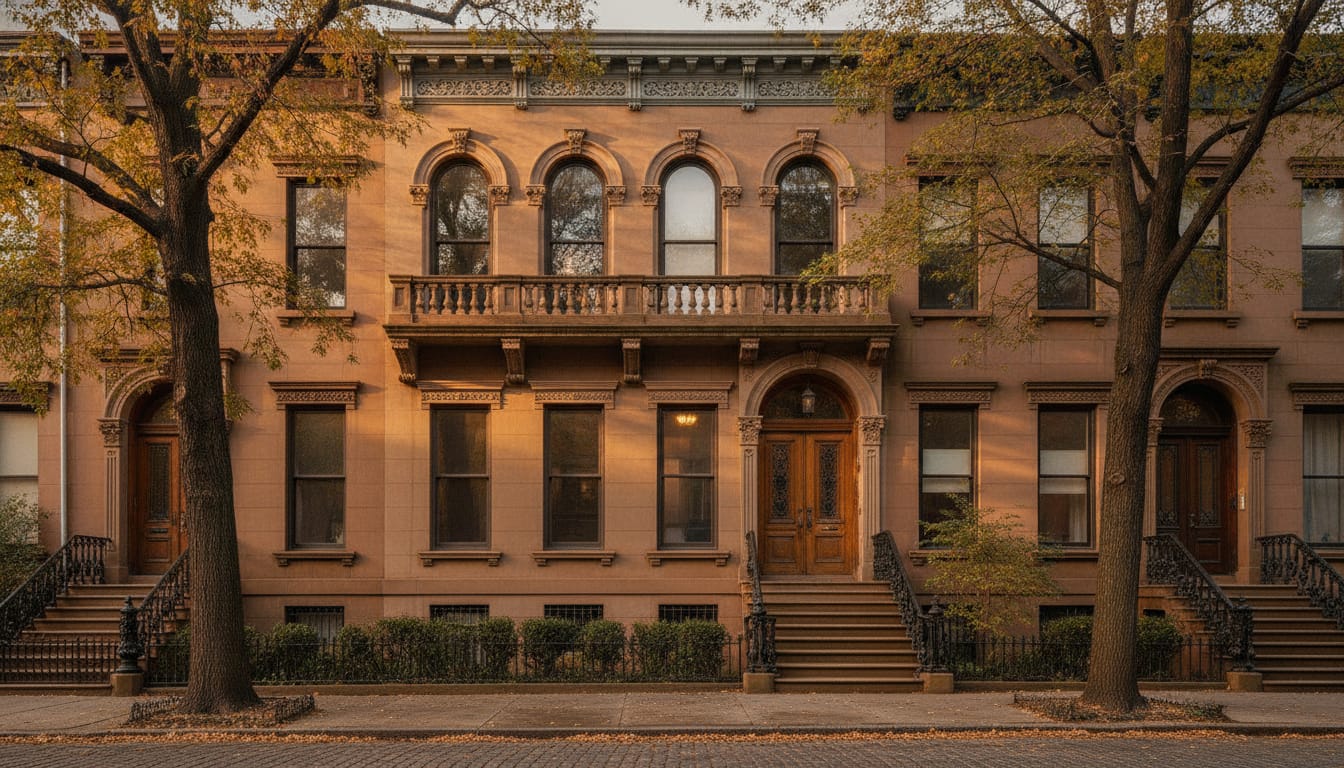
To sell a brownstone in NYC, you confirm the legal unit count on the certificate of occupancy, check for open violations, deliver New York's property condition disclosure statement before the buyer signs, document any tenants and landmark permits, price the house off closed house sales, and then sign a contract and close through attorneys. There is no board. You sell real property with a deed, and the buyer's attorney, lender and title company examine the house itself. On a one to three family house above $500,000, the seller pays New York City's transfer tax of 1.425% and New York State's of 0.4%, which comes to $36,500 on a $2,000,000 sale before commission, attorney fees and any mortgage payoff.
Since I started in NYC real estate in November 2001, the house sales I have seen renegotiated late rarely turn on the kitchen or the stoop. They turn on public records the seller could have pulled before listing: a certificate of occupancy showing fewer legal units than the house is used for, an old open violation, or facade work done without a landmarks permit. This guide puts those checks first.
"Brownstone" and "townhouse" are used loosely here. Both cover the 19th century rowhouses found across Brooklyn, Harlem and other parts of the city, and many are legally two to four family houses today. If yours has rental units, read sell, hold or exchange a long-held 2 to 4 family alongside this guide.
Selling a house is not selling an apartment
Selling a brownstone or townhouse
- • No board; you convey the house by deed
- • A property condition disclosure statement is required for one to four family houses
- • The certificate of occupancy and legal unit count get checked
- • Any tenants and their leases come with the house
- • Landmark permits matter in a historic district
Selling a co-op or condo
- • A co-op board approves the buyer; a condo board usually holds a right of first refusal
- • No disclosure statement; the law excludes condo units and co-op apartments
- • The building's documents drive most of the buyer's review
- • Building fees, and a flip tax in many co-ops
Step 1: Pull the certificate of occupancy and count the legal units
A certificate of occupancy, or CO, tells you how a building can legally be used, including how many homes it may hold. Look up the address on the Department of Buildings' Buildings Information System (BIS) or its DOB NOW public portal. Many rowhouses are older than 1938, and for a building built or altered before 1938 that did not need a CO at the time, the Department of Buildings says an owner may get a Letter of No Objection to confirm its legal use.
Then compare the paper to the house. If the records say two family and the house runs as three apartments, the third unit is not a legal use, and the buyer's attorney and the lender's appraiser will both see it. Expect the buyer to price in the gap or ask you to fix it, and decide which answer you are giving before you list.
Step 2: Look up open DOB and HPD violations
Two city agencies issue the violations a buyer will find: the Department of Buildings (DOB) for construction and building code issues, and the Department of Housing Preservation and Development (HPD) for housing maintenance code issues. DOB items appear on BIS and DOB NOW and HPD items on HPD Online, or run your address through the free building check to see both in one place.
A buyer prices an open violation the cautious way, as the repair cost plus a margin for what they cannot see. Clearing what can reasonably be cleared before you list often costs less than that discount.

Townhouses & Single-Family Homes
Brownstones and townhouses currently for sale in Manhattan and Brooklyn

138 W 82nd Street
Upper West Side

2136 E 28th Street
Sheepshead Bay
Listing information provided courtesy of the Real Estate Board of New York's Residential Listing Service (RLS). Information is deemed reliable but not guaranteed. Sale listings verified. ©2026 REBNY. RLS data displayed by Keller Williams NYC.
Step 3: Complete the property condition disclosure statement
Under Real Property Law section 462, a seller of a one to four family house must complete and sign a property condition disclosure statement and deliver it to the buyer or the buyer's agent before the buyer signs a binding contract. Since March 20, 2024, the old option of giving the buyer a $500 credit instead of the form is gone. To sell a brownstone today, plan on filling out the form.
The form asks what you actually know about the structure, systems, environmental items and flood history, including FEMA flood zones. It is not a warranty, and the law does not require you to inspect the house or search public records to complete it. Answer from what you know and check "unknown" when you do not. If you later learn something that makes an answer materially inaccurate, the law requires a revised statement before the buyer takes title or occupancy. Under section 465, a seller is liable for the buyer's actual damages for a willful failure to comply. Section 463 exempts some transfers, such as court-ordered sales and transfers between spouses; your attorney confirms whether yours is one.
Pull these before you list
From the city: the certificate of occupancy or Letter of No Objection, open DOB and HPD violations, and your deed from ACRIS so you know who must sign at closing.
From your files: a draft disclosure statement, every lease, security deposit records, rent registrations, and LPC permits for past exterior work.
From your lender: a current mortgage payoff statement.
Step 4: If the house has tenants, build the tenant file
Selling does not end a lease. The buyer takes title subject to the existing leases and becomes the landlord, as covered in selling with a tenant in place. Expect the buyer to ask for each signed lease, a rent roll, security deposit records, and a tenant estoppel certificate, a short document the tenant signs confirming the rent, the deposit and the lease term.
If any unit is rent-stabilized, the sale does not end its regulated status, and the buyer will ask for the rent registration history filed with New York's Division of Housing and Community Renewal, because the unit will be underwritten at its registered legal rent. At closing, General Obligations Law section 7-105 requires you to turn tenant security deposits over to the buyer at delivery of the deed or within five days and notify each tenant by registered or certified mail.
Step 5: If the house is landmarked, gather the LPC permits
Some brownstone blocks sit inside historic districts. For a building in a historic district or an individual landmark, the Landmarks Preservation Commission (LPC) reviews most exterior changes to the front and rear facades. Ordinary repairs, such as replacing broken window glass, do not need an LPC permit. Interior work does when it needs a Department of Buildings permit or affects the exterior. Work done without a permit can bring a warning letter and then a notice of violation.
Gather the LPC permits for any exterior work done on your watch. A buyer planning work will read landmark status into the budget, as the brownstone renovation cost guide explains.
Step 6: Price it off closed house sales
The fastest way to sell a brownstone at the right number is to price it the way the buyer's appraiser will: against closed sales, not asking prices. Price per square foot spreads widely across houses, and two things move it most: condition, since a house needing a full renovation and one ready to move into are different products, and legal use, since a one family house and a legal three family with rent coming in draw different buyers. Compare your house to closed sales of similar legal use and condition, then adjust. See pricing a NYC home with a CMA for how that comparison is built.
See what your house nets at your asking price
Run the Net Proceeds CalculatorStep 7: Sign the contract
In New York City the seller's attorney drafts the contract of sale and the buyer's attorney reviews it. The buyer typically puts down a 10% deposit at signing, held in escrow until closing, and the buyer's side orders a title search that will surface liens and open violations. I keep a list of attorneys I can suggest, and you choose your own.
Step 8: Close
At closing the deed transfers, the title company collects and files the transfer tax returns, your mortgage is paid off from the proceeds, and in a house with tenants, rents are apportioned and security deposits change hands.
What a brownstone seller pays at closing
The seller pays both transfer taxes on a resale, and the legal unit count matters here too: New York City taxes a one to three family house at its residential rates and a four family house at the rates for all other property. The buyer pays New York State's mansion tax, which starts at 1% of the price at $1,000,000.
| Cost | Rate or amount |
|---|---|
| NYC transfer tax, one to three family | 1% up to $500,000; 1.425% above, on the full price |
| NYC transfer tax, four family | 1.425% up to $500,000; 2.625% above, on the full price |
| NY State transfer tax | 0.4%; 0.65% on NYC residential sales of $3,000,000 or more |
| Broker commission | Negotiated in the listing agreement |
| Your attorney | Usually a flat fee; get it in writing |
| Mortgage payoff | Per your lender's payoff statement |
Transfer taxes at four prices
$1,200,000 two family: city 1.425% = $17,100; state 0.4% = $4,800; total $21,900.
$2,000,000 three family: city 1.425% = $28,500; state 0.4% = $8,000; total $36,500.
$3,500,000 one family: city 1.425% = $49,875; state 0.65% = $22,750; total $72,625.
$2,000,000 four family: city 2.625% = $52,500, plus state tax at the rate your attorney confirms for a four family house.
The line-by-line version is in NYC seller net proceeds.
Taxes on the gain
If the house was your main home for at least two of the five years before the sale, section 121 of the Internal Revenue Code lets you exclude up to $250,000 of gain, or $500,000 for most married couples filing jointly. In a house with rental units, only the gain on your own unit can qualify, and the exclusion does not cover depreciation taken on the rented part, which is taxed at a federal maximum of 25%. A 1031 exchange can defer the gain on property held for investment, meaning the rental units and not your own home, on strict 45 and 180 day deadlines. More in the capital gains guide and the 1031 exchange guide for NYC sellers.
Common questions
Can I sell a brownstone that has more apartments than its certificate of occupancy allows?
A sale is still possible, but the buyer's attorney and the lender's appraiser will compare the records to the house and treat the extra unit as something to price in or fix. Decide before you list whether to legalize it, convert it back, or price the house on its legal unit count.
Do I still have to fill out the property condition disclosure statement?
Yes, for a one to four family house, unless your sale falls under an exemption in Real Property Law section 463. Since March 20, 2024, a $500 credit no longer replaces the form.
Do my tenants have to move out before I sell my townhouse?
No. Leases survive a sale, and the buyer becomes the landlord. If a buyer wants a unit delivered vacant, get your attorney's answer on the lease and the law before the contract promises it.
Planning to sell a brownstone or townhouse?
Milton Coste, Licensed Real Estate Associate Broker, 25+ years in NYC real estate with more than 1,100 transactions across the five boroughs. Send me the address and I will come back with the closed house sales I would price it against and what it nets you.
Get Your House's Price and NetThis is general information, not legal or tax advice. Sources: NY Real Property Law sections 462, 463 and 465, General Obligations Law section 7-105, NYC and NYS transfer tax guidance, NYC DOB and LPC guidance, and IRC sections 121 and 1031.