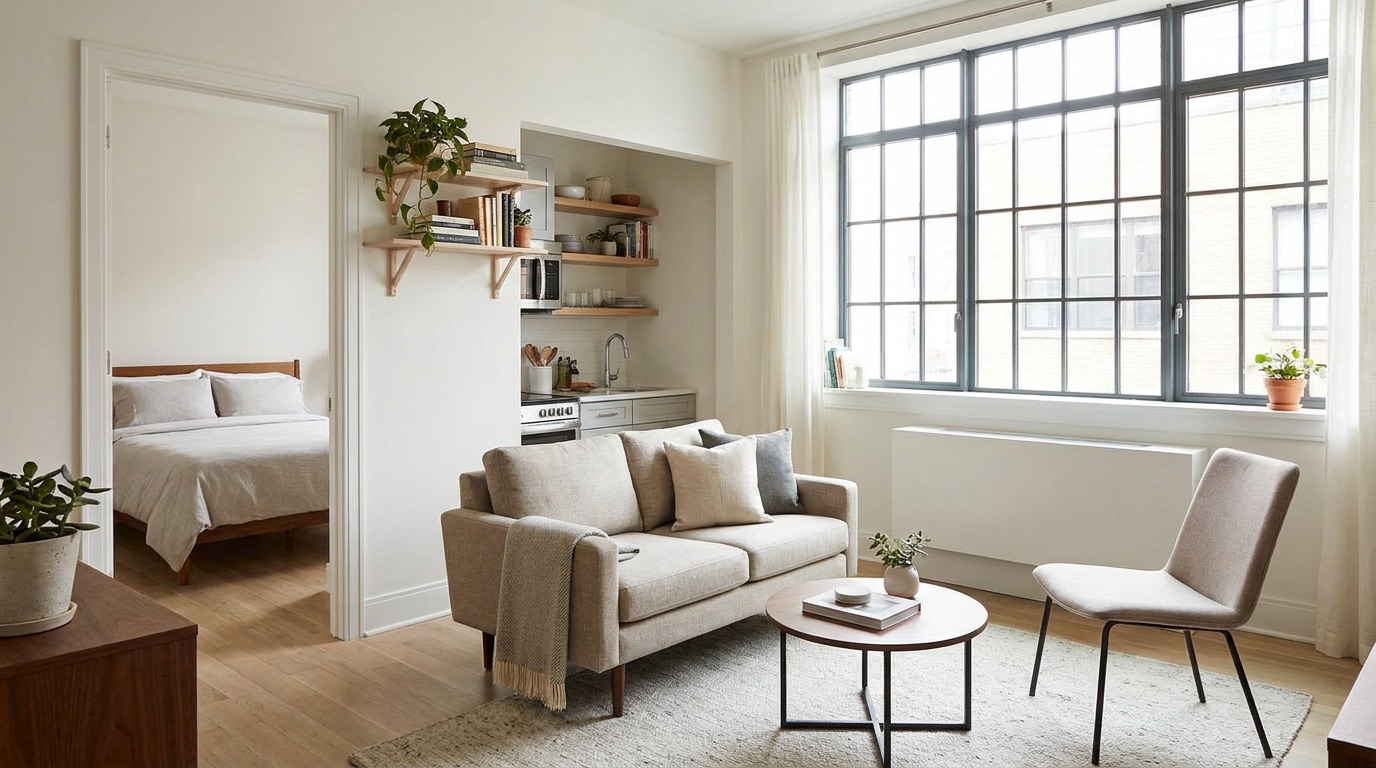

New York gives a buyer no legal right to light, air, or a view unless someone put it in writing and recorded it. A neighbor who builds within the zoning rules and walls off your windows has not caused any injury a court will repair. That one rule is why views versus space is a financial decision in this city rather than a matter of taste.
Square footage cannot be taken away by a construction crane. A view can. The two sides of this tradeoff carry different kinds of risk, and most buyers price them as though they were the same kind of purchase.
I have been doing NYC deals since November 2001, and the question shows up at nearly every second showing once a search crosses seven figures. The same money buys a bright upper-floor apartment with a tighter floor plan, or a larger one on a low floor facing a wall. Here is how each side gets priced, how to check what you are actually buying, and how to decide based on the way you use an apartment rather than the way it photographs.
New York does not owe you your view
Under settled New York law there is no easement of light and air unless it is created by express grant. An owner may build on their own land and remove the light, air, and outlook an adjoining owner previously enjoyed without inflicting a legal injury, and blocking a neighbor's view with new construction is generally not an actionable nuisance.
The exception is the thing worth hunting for. Express easements of light, air, and view can be granted in writing, and New York courts have upheld them. The city's Department of Buildings publishes a standard light and air easement agreement form, which tells you how routine these instruments are on tight blocks. When one exists, it is recorded against the burdened lot, so you can find it before you sign.
"Protected view" therefore has a narrow meaning at the contract table. It does not mean the outlook is beautiful, and it does not mean the neighbor probably will not build. It means at least one of these is true:
- The apartment faces something that cannot be built on, such as a park, a river, a cemetery, or a rail cut.
- An express light and air easement is recorded against the lot in front of you.
- The lot in front has already sold or transferred its unused development rights, so there is little or nothing left to build with.
- The block is inside a historic district, where the Landmarks Preservation Commission reviews the height of new buildings and additions against the character of the district before a Certificate of Appropriateness is issued.
Everything else is a view you are renting from your neighbor's balance sheet.
What the floor-by-floor price pattern looks like
The most-cited public breakdown of floor pricing in Manhattan is still the analysis Jonathan Miller of Miller Samuel ran for The Real Deal, published in June 2010, using every closed co-op and condo sale in Manhattan during 2009. Those dollar figures are old and should not be used as current pricing. The shape of the curve is the part that has held up, and it is not the shape most buyers assume.
The curve is steepest at the bottom, not the top
In that 2009 data set, the first floor was the only floor with an average price per square foot below $800. The single largest step in the whole building was from the first floor to the second, at roughly 19 percent, followed by another 11.4 percent from the second to the third. Prices crossed $1,000 per square foot at the seventh floor.
Higher up, the steps flattened and stopped moving in one direction. The 20th floor averaged $1,418 per square foot while the 22nd averaged $1,347, which is the statistical way of saying that above a certain height the market stops paying for altitude and starts paying for the specific outlook, exposure, and layout of the specific line.
The practical reading: buying up from a ground or second floor is where floor height does the most work per dollar. Buying up from the 18th to the 24th floor of the same line is where a broker's "higher is better" instinct is weakest, and where you should be asking what changes about the actual window rather than what changes about the number on the door.
Four public records that tell you whether the view survives
This is the part almost no buyer does, and it takes about twenty minutes per building. Every one of these sources is free.
| Source | The question it answers |
|---|---|
| ZoLa, the City Planning zoning and land use map | What zoning district the lot across from you sits in, and what floor area ratio applies. Floor area ratio multiplied by lot area is the permitted floor area, which is the ceiling on what can go up there. |
| ACRIS, the city register's property records | Whether a zoning lot development agreement, an air rights transfer, or a light and air easement has been recorded against the neighboring lot. The city also publishes an ACRIS air rights data set on NYC Open Data. |
| DOB NOW Public Portal and the older BIS system | Whether anything is already filed. Both search by address, borough-block-lot, or BIN. A new building application on the lot in front of your prospective windows is the clearest possible answer. |
| Landmarks Preservation Commission maps | Whether the facing lot is inside a historic district or individually landmarked, which subjects the height of new construction to Commission review. |
If ACRIS is new to you, I wrote a full walkthrough of searching deeds, mortgages, and recorded agreements by address in the ACRIS property records guide. The same search that shows you a building's mortgage history will show you whether its neighbor sold off its air.
Read what you find as probability, not prophecy. Unused development rights across the street are not a promise that anything gets built, and a filed application is not a promise that it finishes. A probability you can price still beats a listing agent's assurance that the view is "protected."
Want the view research done before you bid?
I run the zoning, air rights, and permit checks on the lots around a building as part of due diligence, not after the offer is accepted.
Schedule a Buyer Consultation
Active $1M+ Listings
Currently available Manhattan and Brooklyn sales above $1 million

381 Manhattan Avenue
East Williamsburg

220 LINCOLN Road
Prospect Lefferts Gardens
Listing information provided courtesy of the Real Estate Board of New York's Residential Listing Service (RLS). Information is deemed reliable but not guaranteed. Sale listings verified. ©2026 REBNY. RLS data displayed by Keller Williams NYC.
Square footage is priced differently, and measured differently
Here is a fact that reframes the whole tradeoff. Since April 1, 2022, appraisers on loans sold to Fannie Mae have had to measure and report living area under the ANSI Z765-2021 standard. Fannie Mae has been explicit that the trigger is the architectural design of the dwelling rather than the form of ownership, so a townhouse or rowhouse gets ANSI treatment whether it is fee simple or a condominium.
An apartment-style unit in a condo or co-op building is the opposite case. ANSI does not apply, and the appraiser measures the interior perimeter, paint to paint. That is the number a lender's valuation ends up resting on, and it is frequently not the number on the listing, because apartment square footage in this market comes from floor plans, offering plans, prior listings, and estimates rather than from one mandatory standard.
Two consequences follow for a buyer choosing between space and altitude:
- Extra square footage only shows up in an appraisal to the extent it is real interior area. A large terrace, a deep alcove behind a wall, or a generous common hallway does nothing for the measured living area.
- Because there is no single mandatory measuring standard for apartment units, a price per square foot comparison between two listings can be comparing two differently produced numbers. Compare floor plans, not just headline figures.
View is handled the other way around. It is an adjustment an appraiser makes by comparing your unit to sales in similar lines and similar buildings, which is exactly why closed sales in the same building matter so much on a high-floor purchase. My appraisal guide for buyers and sellers covers what happens when that number comes in short.
Light and exposure sit between the two
The most underweighted variable in this decision is not the view and it is not the floor plan. It is exposure. Direction, window count, ceiling height, and how far away the facing wall stands all change how an apartment lives every single day, while the postcard view is something most owners stop noticing within a season.
Exposure also degrades more gracefully. A south-facing line with open air to the next building keeps most of its light even if that lot is developed to its permitted height, because the city's bulk rules govern height, setbacks, and yards there too. A single dramatic sightline down an avenue is closer to a binary bet: it survives or it disappears.
If your budget cannot buy both, exposure is usually the more durable purchase of the two, and it is the one most likely to be undervalued in the asking price because it does not photograph the way a skyline does.
The threshold math underneath the choice
Paying up for a view is not only a price decision, because New York's transfer taxes step at round numbers. The mansion tax starts at 1 percent on contracts of $1 million and rises to 1.25 percent at $2 million, and because the rate applies to the entire purchase price, crossing a threshold is a cliff rather than a slope. A view premium that moves a contract from $1,999,999 to $2,000,000 adds about $5,000 in tax on top of the extra dollar. The full mansion tax bracket table shows where every step sits, and the closing cost breakdown puts it next to everything else due at the table.
The same arithmetic matters when a view apartment draws competing bids. If you are structuring an offer that can climb, read the escalation clause guide before you write a number that pushes you across a tax bracket you did not budget for.
Deciding by how you use the apartment
Strip out the aesthetics and this is a question about hours. Count the hours per week you will spend in the apartment doing something that needs a room, and the hours you will spend doing something that needs a window.
Space usually wins when
- • One or both of you work from home and need a door that closes
- • A second bedroom or a real dining area is the difference between staying five years and staying two
- • You entertain in the apartment rather than out of it
- • The building is a walk-up or a low-rise where the top floor carries no meaningful outlook anyway
- • The extra room is measurable interior area rather than terrace or alcove
Height and outlook usually win when
- • The apartment is a second home or a low-occupancy pied-a-terre
- • The outlook is structurally durable: park, river, rail cut, landmarked low-rise, or a lot with its air rights already sold
- • You are moving up from a first or second floor, where the pricing curve is steepest
- • The lower-floor alternative faces a wall within arm's reach, which costs you light every day, not just the postcard
- • The building's high-floor lines trade at a consistent, verifiable spread in its own closed sales
The one answer I push back on is the buyer paying a large premium for a high floor whose outlook depends on a low building across the street that nobody has checked. That is where the money is genuinely at risk, and it is the version that twenty minutes in ZoLa and ACRIS would have priced correctly before the offer went in.
Working out where your budget should go?
I represent buyers across all five boroughs and Hudson Valley. Some of the deals I have closed are at miltoncoste.com/listings.
Schedule a Consultation