NYC Townhouse Buyer's Guide: What Apartment Buyers Miss
Search, valuation, and due diligence rules that do not carry over from buying an apartment
Milton Coste, Licensed Real Estate Associate Broker•Keller Williams NYC•NY Lic. #10301213304
August 31, 2026• 8 min read•25+ Years Experience
In the five boroughs, the 2026 conforming loan limit is $1,209,750 on a one-family house and $1,548,975 on a two-family. Same block, same borrower, same lender: adding a legal second unit raises the conforming ceiling by $339,225 before anyone talks about jumbo terms.
That is one of about a dozen places where buying a house in New York City stops behaving like buying an apartment. Almost every habit an apartment buyer brings to a townhouse search, from how they filter listings to how they read price per square foot, produces the wrong answer on a house.
I have been doing NYC deals since November 2001, and my sales practice runs across Manhattan, Brooklyn, and Queens. What follows is the order I work a house purchase in, with Brooklyn Heights as the running example because it is the oldest and most tightly regulated townhouse market in the city. Nothing here is legal, tax, or engineering advice. I keep a list of real estate attorneys I can suggest and clients pick from that list, which is what New York State rules require of a broker.
A townhouse search is an inventory problem, not a filter problem
Apartment buyers search by narrowing. Twelve buildings, forty units, three that fit. House buyers cannot do that, because in most NYC neighborhoods the entire year's supply of houses is small enough to count, and no two of them are comparable in the way two lines in the same condo tower are comparable.
The classification quirk makes it worse. In the RLS feed, houses are filed as single-family or multi-family residences. There is no dependable "townhouse" category, so a search built on that word returns almost nothing while dozens of actual townhouses sit under the multi-family label. A buyer running portal filters alone will conclude there is no inventory when the real problem is the taxonomy.
So the search has to be run by property type and lot characteristics rather than by the word "townhouse." And because a meaningful share of house transactions move through broker relationships and off-market channels before any public listing exists, a buyer working only from portals is shopping a partial market.
Why price per square foot travels badly on a house
On a condo line, price per square foot is a reasonable shorthand because the units are close to identical. On houses it hides more than it reveals, and the reasons are physical.
Lot width is the first one. A 25-foot-wide house is not a 20-foot house with 25 percent more of everything. The extra five feet changes the stair layout, the room proportions, and whether a floor can hold two real bedrooms alongside a bathroom. Buyers routinely pay a disproportionate premium for width, and the per-square-foot math never explains why.
Then there are unused development rights, whether the building sits below what the zoning allows and could support an extension or a rooftop addition. There is condition, which on a 150-year-old house is structural and mechanical rather than cosmetic. There is outdoor space. And there is income, because a house with a legal rental unit is partly valued off the rent it produces.
The workable approach is to price the components: the shell and its condition, the lot and what the zoning permits on it, the income if any, then adjust for delivery condition. For the renovation side of that math, the brownstone buying guide covers the building-specific costs. This article is the acquisition process around it.
Delivered vacant, or delivered occupied
This single line in the listing changes the price more than almost anything else, and apartment buyers have no equivalent for it.
A house delivered vacant can be renovated, reconfigured, or occupied in full on day one. A house delivered with tenants comes with whatever rights those tenants hold, and those rights survive the closing. The buyer inherits the leases, not a clean slate. Before contract, ask for the rent roll, every lease and renewal, and the DHCR rent registration history for any unit that might be rent-stabilized. Have the attorney read them rather than reading them yourself.
The question to ask before you write an offer
Is the house being delivered vacant, and is that promise written into the contract with a remedy if it is not met at closing? A verbal assurance that "the tenants are leaving" is not a delivery condition. If your plan for the house requires vacancy, the contract has to say so.
If the income is the point rather than an obstacle, the mechanics of underwriting a two- to four-unit building are covered in the NYC 2-4 unit multifamily guide.
Active Townhouse & Multi-Family Listings
Houses and small multi-family buildings for sale in Brooklyn and Manhattan
Brooklyn Heights: buying inside the city's first historic district
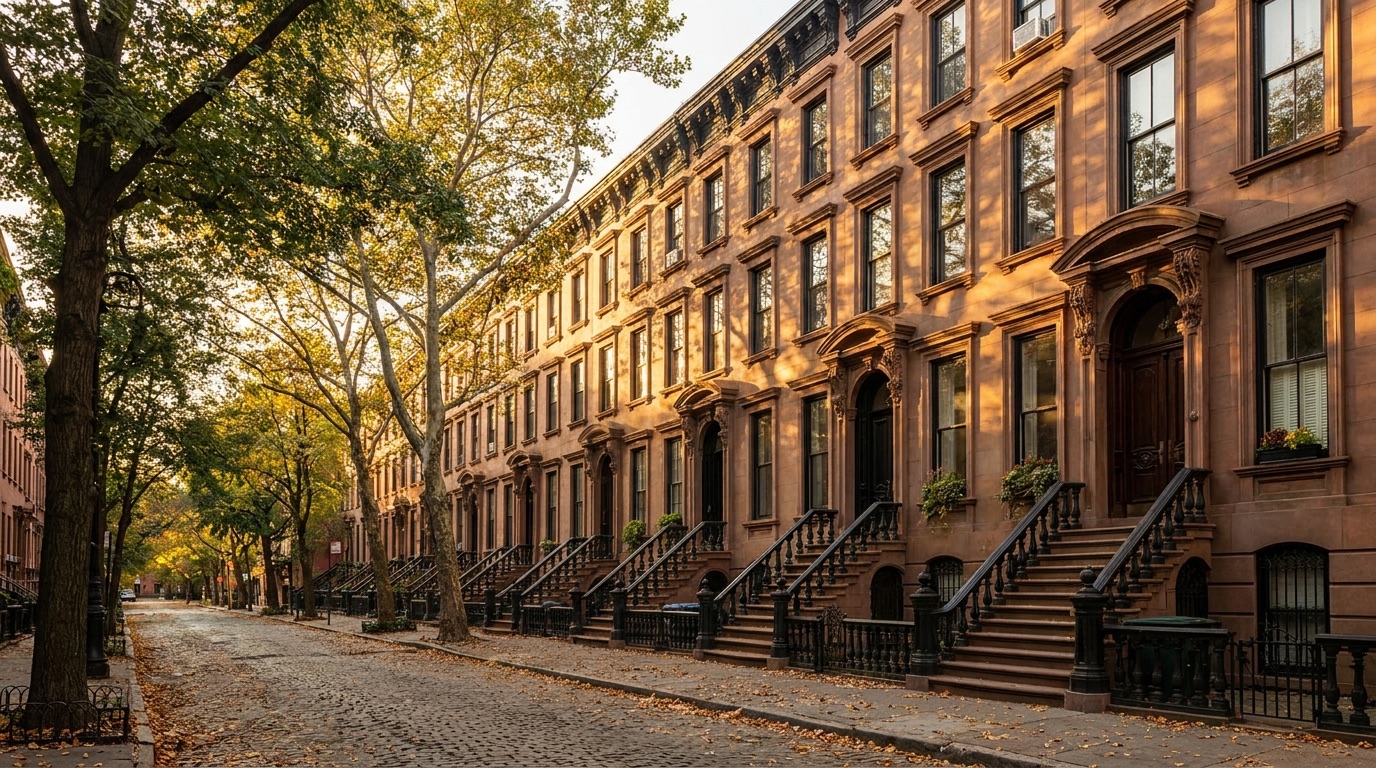
On November 23, 1965, months after the Landmarks Law took effect, the Landmarks Preservation Commission designated Brooklyn Heights as the first historic district in New York City. The rowhouse stock inside it runs across Greek Revival, Italianate, Second Empire, and Victorian Gothic, much of it built between the 1820s and the 1890s. The Promenade sits above the Brooklyn-Queens Expressway on the western edge, Brooklyn Bridge Park runs below it, and the 2 and 3 at Clark Street, the A and C at High Street, and the 4, 5, and R at Borough Hall and Court Street put the district a few stops from Lower Manhattan.
The designation is the part that changes the purchase. Inside a historic district, most exterior alterations to the front and rear facades require an LPC permit before any work begins, and a Department of Buildings permit does not substitute for one. Ordinary maintenance is exempt: replacing broken glass, repainting the exterior in the existing color, caulking around windows and doors.
LPC permit type
Typically covers
Review level
Permit for Minor Work
Work with no effect on protected features and no DOB permit
Staff
Certificate of No Effect
DOB-permitted work that does not affect protected features
Staff
Certificate of Appropriateness
Visible exterior changes, additions, window and facade replacement
None of this makes a landmarked house a bad purchase. It makes the renovation timeline longer and the scope less flexible than the same work on an unregulated block, and that belongs in the underwriting before the offer rather than after the contract.
Shopping Townhouses in Brooklyn or Manhattan?
I read the certificate of occupancy, the violation history, and the landmark status before my clients write an offer, not after. Some of the deals I have closed are at miltoncoste.com/listings.
The due diligence apartment buyers never have to run
In a condo or co-op, the building's systems are somebody else's problem and the financials tell you how well that problem is being managed. On a house, you are the building. Six items sit outside anything an apartment buyer has done before.
The engineer's report. Not an inspection checklist, an engineering review of the structure, roof, facade, foundation, and mechanicals. On a house from the 1800s this is the single most valuable few hundred dollars in the transaction.
Party walls. Attached houses share their side walls with the neighbors, and repairs frequently require getting onto the adjoining property. New York has a statute for exactly that impasse: RPAPL 881 lets an owner petition a court for a license to enter a neighbor's property when access is necessary and has been refused. Governor Hochul signed an amendment to that section on December 5, 2025, tightening when a neighbor is treated as having denied access and what conditions a court can attach to the license. If your plan involves facade or roof work on a shared wall, the attorney should read the current version.
The certificate of occupancy, or its substitute. New York City did not generally require a certificate of occupancy for buildings completed before January 1, 1938, which describes most of the townhouse stock. For those, the Department of Buildings can issue a Letter of No Objection confirming it has no objection to the current legal use. If the house has neither a C of O nor an LNO matching how it is actually being used, that gap needs resolving before closing, not after.
Heating fuel. Local Law 32 of 2023 moved the deadline to stop burning No. 4 heating oil in non-municipal buildings up to July 2027, three years earlier than the original schedule, and DOB stopped issuing and renewing No. 4 boiler permits on June 30, 2024. Penalties run to $10,000. If the house still burns No. 4, conversion is a dated capital item, not a maybe.
Open violations. DOB, ECB, HPD, and, in a historic district, Landmarks. These attach to the property, not the seller, and some of them block a future permit application.
Water, sewer, and vault. Unpaid water and sewer charges become a lien. Sidewalk vaults under the stoop area carry their own charges and repair obligations.
One family, two family, four family: what the configuration decides
The number of legal units is not a lifestyle detail. It changes the code, the financing, and the exit.
Under the New York Multiple Dwelling Law, a building occupied as a residence by three or more families living independently is a multiple dwelling, which brings a different set of code obligations than a one- or two-family house. That threshold is why so many NYC houses are configured as two-family: it is the largest configuration that stays outside multiple-dwelling treatment.
Buyers regularly plan to convert, usually a four-family back to a one- or two-family for their own use, or the reverse to create rental income. At a high level, a conversion means an architect, a DOB alteration filing, work that meets current code for the new occupancy, an amended certificate of occupancy at the end, and in a historic district an LPC permit for anything visible from the street. Budget the time, not just the money, and remember that reverting later is another full filing.
The financing gap most townhouse buyers never hear about
Conforming loan limits in New York City are set by unit count, and the steps are large. These are the 2026 figures published by the Federal Housing Finance Agency for the five boroughs, all of which sit at the same high-cost level.
Legal units
2026 NYC conforming limit
Gain over one unit
1
$1,209,750
-
2
$1,548,975
$339,225
3
$1,872,225
$662,475
4
$2,326,875
$1,117,125
Source: FHFA 2026 conforming loan limit values, Bronx, Kings, New York, Queens, and Richmond counties. Baseline for most of the country is $832,750.
Above those figures the loan is a jumbo, priced and underwritten to a different standard: larger down payment, documented post-closing reserves, and a lender that keeps the loan rather than selling it. Two buyers at the same purchase price can land on opposite sides of that line purely because of how the certificate of occupancy reads. Ask the lender to quote the house as it is legally configured, not as it is being used.
A lender underwriting a two- to four-unit house will also count part of the projected rental income toward qualifying, subject to its own documentation rules. Get that in writing from the loan officer, because the treatment varies by lender and by whether the unit is currently leased.
Carrying a house versus carrying an apartment
Townhouse
• Full property tax bill, no common charge
• Heat, hot water, electric, water and sewer all direct
• Homeowner policy sized to full replacement cost
• Roof, facade, boiler, and plumbing are capital items you fund
• No board approval to buy, sell, renovate, or rent
• Rental income possible if the units are legal
Condo or co-op
• Monthly common charge or maintenance, plus assessments
• Building handles most systems and capital work
• Interior-only insurance policy
• Co-op maintenance carries your share of the building tax
• Board approval on purchase, alterations, and subletting
• Sublet policy set by the building, not by you
Neither column is cheaper by default. The house trades a predictable monthly number for control and a lumpy capital schedule. The realistic way to compare them is to price a reserve against the engineer's report, so a roof replacement in year four is a line you funded rather than a surprise.
Closing costs also change shape. On a purchase at or above $1 million the New York State mansion tax applies, starting at 1 percent and rising in tiers to 3.9 percent, and the applicable rate hits the entire price rather than the amount above the threshold. Run the numbers in the mansion tax guide and the full NYC closing cost breakdown before you set your offer ceiling, and confirm the tax treatment with your accountant.
The order I would work it
1. Legal status first
• Certificate of occupancy or Letter of No Objection
• Unit count, zoning, and landmark status
• Open DOB, ECB, HPD, and LPC violations
2. Physical condition second
• Engineer's report on structure, roof, and facade
• Party wall condition and access requirements
• Heating fuel, boiler age, and the 2027 No. 4 deadline
3. Occupancy third
• Vacant delivery written into the contract, or not
• Leases, rent roll, and DHCR registration history
• Attorney reads the tenancy before you sign
4. Money last
• Loan quoted against the legal unit count
• Mansion tax and closing costs modeled at your ceiling
• Capital reserve funded off the engineer's report
Apartment buyers are trained to evaluate a building someone else runs. Townhouse buyers are underwriting an asset they will run themselves, and the paperwork that describes it, the certificate of occupancy, the violation history, the landmark designation, and the leases, is worth more attention than the finishes. Get those four right and the rest of the purchase is ordinary. Get them wrong and you find out after closing, when every option costs more.
Ready to Look at Houses?
I represent buyers across all five boroughs and the Hudson Valley, in English and Spanish. Tell me the configuration you need and I will tell you what is actually available, including what has not hit the portals.
Send the address you are looking at. The report covers what the listing leaves out: the recorded sale history, the tax and abatement picture, open building violations and permits, and the closed sales that set the price. Milton prepares it from public records. No obligation.
Get NYC market insights delivered to your inbox
New listings, market data, and expert analysis. No spam.