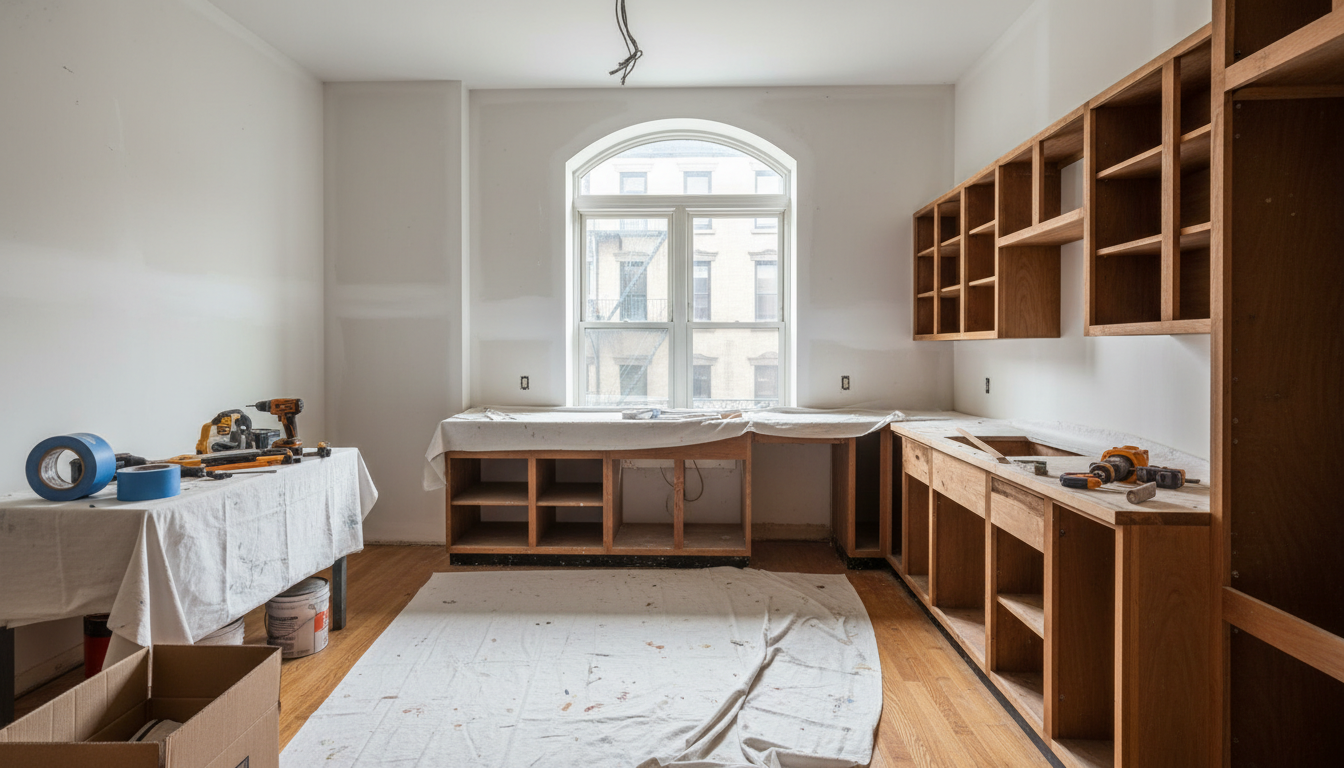
Renovating a NYC co-op runs on the board's clock, not your contractor's. A kitchen or bathroom rebuilt in its existing location typically clears approval in 2 to 4 weeks. Move that kitchen to a new wall and the same building can take 6 to 12 weeks. Add a through-wall HVAC unit and you are looking at 8 to 16 weeks before anyone is allowed through the service entrance. That spread is set by a document called the alteration agreement, it is different in every building, and it never appears in a listing description.
In my 25+ years as a Licensed Real Estate Associate Broker, I have seen buyers fall in love with apartments they planned to renovate, close without reviewing the alteration agreement, and discover that the kitchen relocation they envisioned was prohibited, the washer/dryer installation they planned was not allowed, or the HVAC upgrade they needed was subject to an 18-month approval timeline. This guide covers what the alteration agreement contains, what co-op boards typically allow and prohibit, and the practical timeline for getting work approved and completed.
What Is an Alteration Agreement?
An alteration agreement is a contract between you and the co-op corporation that governs any modification to your apartment beyond basic cosmetic work like painting and furniture placement. Most co-ops require shareholders to sign and return a completed alteration agreement before any permitted renovation work begins. The document specifies the scope of approved work, the insurance requirements for contractors, the hours during which construction noise is permitted, the board's right to inspect, and the financial obligations (deposits, fees) associated with the work.
Alteration agreements are not standardized. Each co-op has its own version, shaped by its building's physical structure, its proprietary lease, and decades of board policy. The alteration agreement for a 1920s Upper West Side prewar building will look substantially different from the agreement for a 1965 post-war high-rise in Queens, because the buildings have different plumbing configurations, different floor-to-ceiling heights, different mechanical systems, and different histories of shareholder disputes over renovation damage.
Request the Alteration Agreement Before You Sign a Contract
Your attorney can request the co-op's alteration agreement as part of due diligence before you sign a purchase contract. This is standard practice and does not signal an unusual request to the managing agent. If you have specific renovation plans, review the alteration agreement with your contractor and your attorney before committing to the purchase price. Do not close on an apartment expecting to renovate it, without knowing what the alteration agreement allows.
Cosmetic Work vs. Permitted Work vs. Board-Approved Work
Co-op renovation work generally falls into three tiers:
Cosmetic work (no approval required): Painting walls, replacing light fixtures with similar fixtures, installing new flooring over existing flooring without touching subfloor, and most furniture-level changes. These typically do not require an alteration agreement or board notice, though some co-ops require notification even for cosmetic work.
Permitted work (alteration agreement required, permits filed with DOB): Any work that requires a permit from the New York City Department of Buildings requires an alteration agreement and, in most buildings, board notification if not explicit approval. This includes replacing windows, installing new plumbing fixtures, opening or closing walls, installing new flooring that requires nail-down installation, and any electrical panel work.
Board-approved work (explicit vote required before starting): Work that affects building systems, wet-over-dry configurations, or structural elements requires an explicit board vote. This includes kitchen and bathroom relocations, washer/dryer installations where not previously permitted, HVAC system installations, wet-over-dry plumbing (installing a wet room above a dry room in the unit below), and any modification to load-bearing elements.
The Wet-Over-Dry Rule: The Most Common Restriction
The wet-over-dry rule is the renovation restriction that surprises the most buyers. In most NYC co-op buildings, you cannot install plumbing in a location that is directly above an existing dry room (living room, bedroom) in the apartment below yours. The reason is practical: plumbing leaks travel down. A bathroom or kitchen placed above someone's bedroom creates a liability risk the co-op board is not willing to accept.
This rule most commonly surfaces when buyers plan to move a kitchen or bathroom from its original location. A buyer who wants to open a wall between the kitchen and living room and reconfigure the kitchen's position may discover that the new position would place the kitchen directly above a neighbor's bedroom, triggering the wet-over-dry restriction. The kitchen cannot move. The renovation scope collapses.
Before finalizing any renovation plan that involves moving plumbing, obtain the building's plumbing stack diagram from the managing agent and have your architect overlay the proposed new positions. This takes one week and costs less than one hour of architect time. It prevents a weeks-long board deliberation that ends in a rejection.

Active Co-op Listings
NYC co-ops available for purchase and renovation, subject to board alteration rules.

242 E 19TH Street #15B
Gramercy Park

1088 PARK Avenue #10C
Carnegie Hill
Listing information provided courtesy of the Real Estate Board of New York's Residential Listing Service (RLS). Information is deemed reliable but not guaranteed. Sale listings verified. ©2026 REBNY. RLS data displayed by Keller Williams NYC.
Board Approval for Renovations: What Gets Reviewed
Signing the alteration agreement is not the approval. It is the application. For any work in the board-approved tier, the managing agent assembles a package and the board votes on it, the same way it votes on a purchase application. Understanding what sits inside that package is the difference between one round of review and three.
A typical board renovation package contains the executed alteration agreement, a scope-of-work narrative, drawings stamped by a New York State licensed architect or professional engineer, the contractor's license and workers' compensation coverage, and certificates of insurance naming the co-op corporation and the managing agent as additional insureds. Buildings with a retained engineer send the drawings out for a third-party technical review, and the shareholder pays for it. That review is where wet-over-dry conflicts, load-bearing questions, and riser capacity problems get caught.
The board then does one of three things. It approves the scope as submitted. It approves with conditions, which is the most common outcome and usually means restricted hours, a specified vendor for one trade, or a reduced scope. Or it denies. A co-op board is not required to explain a denial of a renovation any more than it is required to explain a denial of a purchase application, which is why the useful work happens before the vote, not after it.
What Sends a Renovation Package Back for a Second Round
- Drawings that are not stamped by a licensed New York State architect or professional engineer.
- A certificate of insurance that names the shareholder instead of the corporation and the managing agent.
- A scope narrative that describes the finished apartment but not the work: "new primary bathroom" instead of "relocate the toilet 18 inches, replace the branch line, retile."
- A contractor who is not on the building's approved vendor list for a system-touching trade.
- No plumbing stack diagram overlay on any application that moves a fixture.
Each of those adds a review cycle, and a review cycle is measured against the board's meeting calendar, not against business days. A board that meets monthly turns a paperwork correction into a four-week delay. Boards that go dark in August and late December turn it into eight.
Where the DOB Permit Fits in the Sequence
Buyers often assume the New York City Department of Buildings permit and the co-op approval are two independent tracks they can run at the same time. They are not. The order is fixed, because the DOB application requires authorization from the owner of the building, and in a co-op the owner is the corporation, not you.
The working sequence is: sign and submit the alteration agreement, get the board's approval or conditional approval, obtain the corporation's owner authorization through the managing agent, have your licensed architect or professional engineer file the permit application with DOB, receive the permit, then start work. At the end, the same professional closes out the job with DOB so the record does not sit open.
The city publishes its own numbers on how long the DOB step takes, and they are worth knowing before your contractor quotes you a start date. In the Preliminary Mayor's Management Report for Fiscal 2026, the Department of Buildings reported an average of 23.6 days from filing in DOB NOW to approval across all applications in the first four months of the fiscal year, up from 20.3 days in the same period the year before. First plan review alone averaged 4.2 days for minor alterations and 9.2 days for major ones over that same stretch.
Read that measure carefully before you build a schedule around it. DOB counts both the time an application sits with the Department and the time it sits with your architect waiting on a correction, so a filing that draws objections can run well past the average while the clock keeps counting. Approval is also the step before the permit itself gets pulled, not the permit. And none of it starts until the corporation has signed off, which is the real reason co-op renovations run long. The plan examiner is rarely what is holding you up. The board calendar in front of the filing and the objection cycle behind it are.
That closeout matters more than most buyers expect, because it outlives the renovation. An open or expired permit stays visible in the DOB record and surfaces during the next sale, when the buyer's attorney runs due diligence. You can check what is already on file for any building using the property record trail described in the ACRIS property search guide. If you are buying an apartment that was renovated by a previous shareholder, look for the sign-off before you look at the finishes.
Construction Hours and Noise Rules
NYC co-ops typically enforce narrower construction hours than NYC DOB permits. While the NYC Administrative Code (Section 24-224) generally permits construction noise from 7:00 AM to 6:00 PM on weekdays and 10:00 AM to 4:00 PM on weekends, most co-op alteration agreements restrict work to weekdays only, and many limit hours to 9:00 AM to 5:00 PM or even 10:00 AM to 4:00 PM. A handful of high-end buildings prohibit all construction during July and August or during the December holiday period.
These restrictions directly affect your renovation timeline and your contractor's pricing. A contractor who bids based on a 7:00 AM start time will rebid higher when the co-op's 10:00 AM start time cuts two hours from each workday. Get the construction hour requirements from the alteration agreement before accepting contractor bids, and include them in your request for proposals.
| Renovation Type | Typical Approval Process | Typical Timeline |
|---|---|---|
| Painting, flooring (no subfloor) | None required | Immediate |
| Kitchen renovation (same location) | Alteration agreement + DOB permit | 2-4 weeks for approval |
| Bathroom renovation (same location) | Alteration agreement + DOB permit | 2-4 weeks for approval |
| Kitchen relocation | Board vote + wet-over-dry review | 6-12 weeks |
| Washer/dryer installation | Board vote (if not already permitted) | 4-8 weeks, may be denied |
| Through-wall HVAC / split system | Board vote + architect drawings | 8-16 weeks |
| Window replacement | Board approval + building-specified vendor | 4-6 weeks, often building-mandated brand |
| Wall removal (non-load-bearing) | Alteration agreement + DOB permit | 2-4 weeks for approval |
Financial Requirements: Deposits and Fees
Two separate charges land here and buyers routinely collapse them into one. The first is a refundable security deposit held by the managing agent for the length of the construction period, released after the work is finished, the apartment is inspected, and no damage to common areas has been documented. The second is a non-refundable fee for reviewing the alteration application itself, which you pay whether or not the board ends up saying yes.
I am not going to hand you a dollar range on either one, because there is no standard to quote. Buildings set these amounts themselves and they structure them differently: some size the deposit as a flat sum, others as a percentage of your total construction budget, which means the figure moves with your scope instead of sitting still. Habitat Magazine, the trade publication for NYC co-op and condo boards, published a 2018 rundown of typical alteration charges that described buildings setting the security deposit at 10 to 15 percent of the total renovation budget, with others using a flat figure instead. Treat that as a shape, not a quote, and note the age on it.
The only number that binds you is the one written into your building's alteration agreement and its current schedule of fees. Ask the managing agent for both in writing before you sign anything, and ask specifically whether the deposit is a flat figure or budget-linked. That single answer can move your out-of-pocket by five figures on a gut renovation, and it is the cheapest question you will ask all year.
For extensive renovations, some buildings require the shareholder to post a larger performance bond or escrow a percentage of the construction budget. If a renovation causes damage to common areas, building systems, or neighboring apartments, the deposit is applied to repairs and the shareholder may be liable for amounts exceeding the deposit.
Outside the five boroughs: Westchester and the Hudson Valley
The alteration agreement is a creature of the co-op's proprietary lease, not of New York City law, so it travels. Co-ops in Westchester, Rockland, and up through the Hudson Valley use the same instrument, and the clause structure will look familiar: consent before work begins, an approved contractor with named insurance limits, a deposit, and a restoration obligation if the work is abandoned.
Two things do change once you leave the city. The permit path runs through the local building department rather than the NYC Department of Buildings, so the filing step in the sequence above has a different name, a different fee schedule, and often a faster queue. And the wet-over-dry restriction is less uniformly enforced outside dense prewar stock, though plenty of individual buildings still write it in. Read the agreement rather than assuming the local norm, because the document controls in either place. I work across the five boroughs and the Hudson Valley, so if you are comparing a co-op in one against a co-op in the other, the renovation rules are a fair thing to weigh in the decision.
Common Pitfalls and How to Avoid Them
The most predictable renovation failures in NYC co-ops follow a consistent pattern: the buyer assumes that board approval for a scope of work means unlimited flexibility within that scope, contractors begin work beyond the approved scope, and the managing agent halts construction pending a new application. This adds weeks, sometimes months, to a renovation that could have proceeded smoothly.
A related issue is the contractor who is not on the building's approved vendor list for certain trades. Many co-ops maintain lists of approved plumbers, electricians, or HVAC contractors for work touching building systems. Using an unapproved contractor for these trades, even one who is licensed and insured, can void the alteration agreement and trigger a stop-work order. Confirm the approved vendor list before retaining any trade contractor for system-related work.
For the complete picture of what you are buying when you purchase a NYC co-op, including the proprietary lease, house rules, and financial obligations, see the co-op vs. condo comparison. For the flip tax implications of a co-op sale after renovation, see the NYC flip tax guide. For the full board package process, see the co-op board interview guide.
Buying a Co-op You Plan to Renovate?
Milton Coste reviews alteration agreements and renovation restrictions as part of every co-op buyer representation. Know what you are buying before you close.
NYC Buyer Guide