In the second quarter of 2026, the median sale price in Tribeca was $3,900,000 and the median in SoHo was $3,475,000, per PropertyShark's neighborhood sales trends. Price per square foot ran the opposite direction: $2,043 in Tribeca against $2,106 in SoHo. The neighborhood with the lower median cost more per foot.
That inversion is the whole Tribeca vs. SoHo question in one line. It is not a pricing quirk. It is what happens when you put two different inventories side by side: one built around large converted warehouse footprints and new condo towers, the other around 19th-century cast-iron buildings on 25-foot lots. Bigger units carry a higher total price. Smaller units in scarcer buildings carry a higher price per foot.
I have been selling NYC real estate since November 2001, and the question downtown buyers actually bring me is almost never about which name sounds better on a mailing address. It is whether the apartment they described to me exists in that neighborhood's building stock at all. That is the only comparison worth writing down, so this article stays on property: prices, ownership structure, architecture, landmark rules, transit, open space, and flood exposure. Nothing here is about who lives in either place.
What the Q2 2026 sales data shows
Both neighborhoods trade far above the borough. Manhattan's median sale price in the same quarter was $865,000. Here is the side-by-side, all figures from PropertyShark's Q2 2026 residential market trends for each neighborhood.
| Q2 2026 | Tribeca | SoHo |
|---|---|---|
| Median sale price | $3,900,000 | $3,475,000 |
| Median price per sq. ft. | $2,043 | $2,106 |
| Recorded transactions | 67 | 35 |
| Condo median (sales count) | $3.9M (59) | $6.9M (17) |
| Co-op median (sales count) | $3.6M (8) | $2.8M (18) |
| Manhattan median, same quarter | $865,000 | |
Read the sales counts before you read the medians. Tribeca recorded 67 closings in the quarter against 35 in SoHo, and SoHo's $6.9M condo median rests on just 17 sales. A handful of full-floor loft trades moves a number that small by a million dollars. Treat SoHo's condo median as a signal about which units happened to close, not as a stable price level.
Both medians clear $3 million, which puts a median-priced purchase in either neighborhood several brackets up the state's supplemental transfer tax schedule. If you are budgeting closing costs at this price point, start with the 2026 mansion tax brackets before you shop.
The ownership split is the real fork in the road
This is the difference most Tribeca vs. SoHo comparisons skip, and it decides more buyer outcomes than architecture does. PropertyShark counts individually owned residential units this way:
Tribeca: 6,040 residential units
- • 4,592 condo units
- • 1,412 co-op units
- • 382 residential buildings
- • Roughly three condos for every co-op
SoHo: 3,073 residential units
- • 1,120 condo units
- • 1,919 co-op units
- • 300 residential buildings
- • Co-op units outnumber condos
Tribeca is a condo market with a co-op minority. SoHo is the reverse. That single fact sets your financing terms, your approval path, your purchasing entity, and your timeline. A condo purchase clears on a right of first refusal and a shorter runway. A co-op purchase means a board package, a board interview, financing limits written into the corporation's rules, and sublet and pied-a-terre policies that vary building to building. If you plan to buy through an LLC, plan to rent the unit out, or plan to close fast, that constraint lands harder in SoHo simply because more of the inventory is co-op.
If the structural distinction is new to you, start with how co-ops and condos differ in NYC, then look at the closing timelines each one carries. Co-op closings routinely run 60 to 90 days against 30 to 45 for a condo, and that gap is a real planning input when you are coordinating a sale, a lease expiration, or a school year.
Cast iron on one side, warehouse floor plates on the other
PropertyShark puts the median year of construction at 1938 in SoHo and 1965 in Tribeca. Neither number describes a typical building. Both describe the mix.
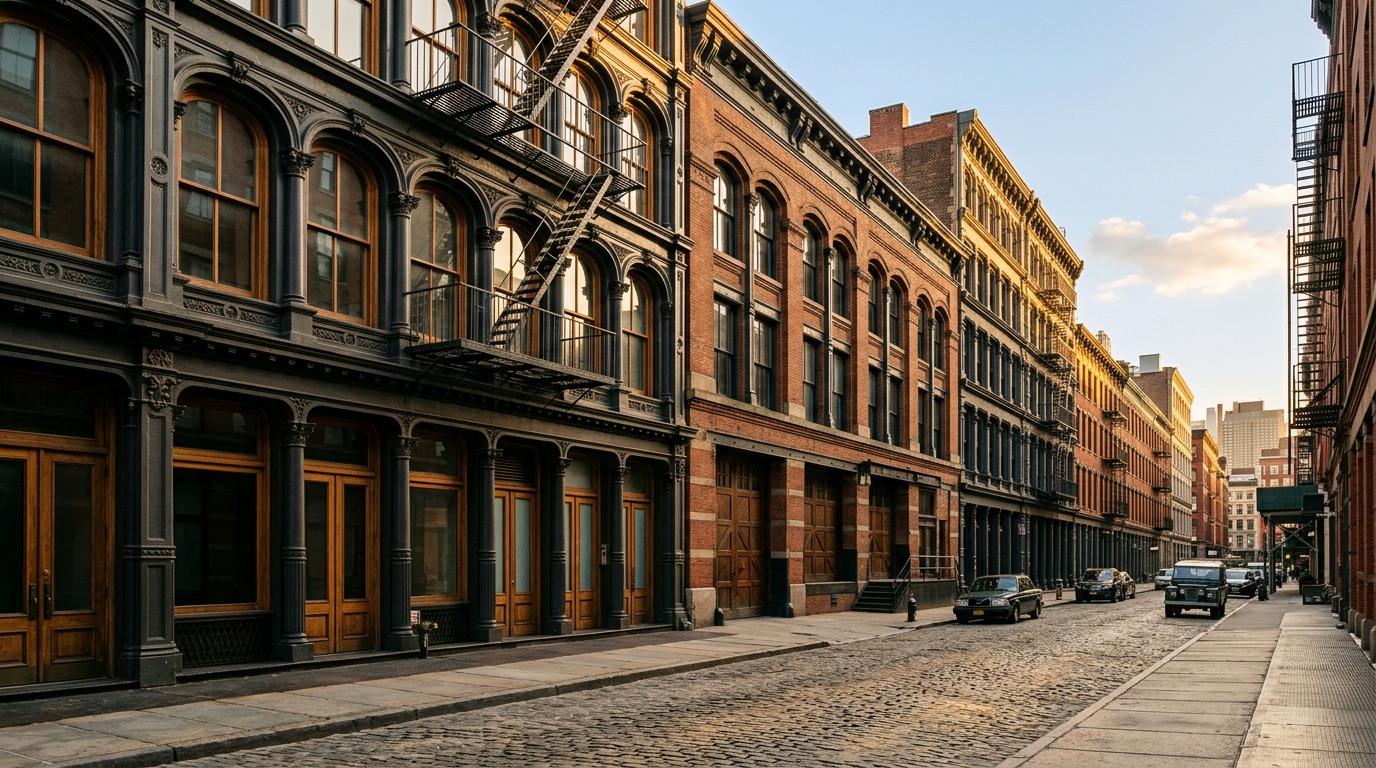
SoHo's core stock is the 19th-century cast-iron store-and-loft type: five and six stories, built on 25-foot lots, with column-free interior spans, tall windows, and ornamental iron facades. The architecture produces long, narrow floor plans with light at the two short ends. Some buildings still run without a doorman or a garage, because they were never built to have one.
Tribeca's stock came out of the Washington Market food and dry-goods trade: deeper, wider warehouse buildings with heavier structure and freight cores. Those footprints convert cleanly into full-floor and half-floor residences, which is why Tribeca holds more three-bedroom and four-bedroom loft product than SoHo does. The 1965 median year is pulled forward by decades of conversion work and by the ground-up condo towers built on blocks that fall outside the landmark districts.
If you are shopping loft product in either neighborhood, the questions that move value are the same in both: certificate of occupancy, legal use, ceiling height, column placement, and window exposure. I covered the full checklist in buying a loft in NYC.

Active Tribeca & SoHo Listings
Current downtown Manhattan sale inventory in both neighborhoods

56 LEONARD Street #29A
Tribeca

55 HUDSON Street #PHD
Tribeca
Listing information provided courtesy of the Real Estate Board of New York's Residential Listing Service (RLS). Information is deemed reliable but not guaranteed. Sale listings verified. ©2026 REBNY. RLS data displayed by Keller Williams NYC.
Landmark coverage and what approval adds to a renovation
The Landmarks Preservation Commission designated the SoHo-Cast Iron Historic District on August 14, 1973, covering roughly 500 buildings across about 26 blocks. The commission designated a district extension on May 11, 2010, adding 135 properties along Crosby and Centre Streets to the east and West Broadway to the west.
Tribeca was protected later and in pieces. Tribeca West was designated May 7, 1991 with about 220 buildings across 17 blocks, followed by Tribeca East, Tribeca North, and Tribeca South in December 1992, with a Tribeca South extension in 2002.
What landmark status changes for a buyer
Exterior work in a designated district needs LPC approval: windows, storefronts, facade repair, rooftop additions, and anything visible from the street. That adds review time and cost to a renovation budget. Interior work is generally outside LPC jurisdiction, but your building's alteration agreement and the co-op or condo board's rules still govern it. The practical difference between the two neighborhoods is coverage, not severity: SoHo's designation blankets the neighborhood core, while Tribeca's four districts leave blocks uncovered, which is exactly where the ground-up condo towers went. Confirm the district status of any specific address with the LPC map and your attorney before you budget a gut renovation.
Shopping Downtown Manhattan Lofts?
Milton Coste is a Licensed Real Estate Associate Broker with 25+ years across all five boroughs. Get a read on which downtown inventory actually fits your footprint and ownership requirements.
Schedule a Buyer ConsultationThe SoHo line item that never appears on a listing sheet
This is the piece of the Tribeca vs. SoHo comparison that costs buyers real money, and it exists on only one side of the border.
For decades, most SoHo living space sat in manufacturing zoning districts where residential use was not permitted outright. What was permitted was Joint Living-Work Quarters for Artists, or JLWQA. Occupancy of a JLWQA unit legally requires certification as an artist by the New York City Department of Cultural Affairs. Over the years those units were widely bought and occupied by people without that certification, a practice that was technically a violation and largely unenforced.
The SoHo/NoHo rezoning adopted on December 15, 2021 changed the underlying zoning to mixed-use districts and created a mechanism to convert JLWQA units into standard residences that anyone may occupy. On July 21, 2022, Governor Hochul signed Bill A9675A, amending Section 276 of the New York State Multiple Dwelling Law so that any permanent occupant living in a JLWQA unit on or before December 15, 2021 is treated as meeting the artist occupancy requirement.
Here is the part that matters if you are buying today: that protection runs to the long-term occupant, not to future purchasers or tenants. A buyer taking title to a unit that is still legally JLWQA either needs the certification or needs the unit taken through the conversion process. Ask for the certificate of occupancy and the unit's legal use in writing, early, and have a real estate attorney review it before you sign a contract. This is not a formality in SoHo, and it has no equivalent in Tribeca.
Trains and open space
Both neighborhoods are well served, in different patterns. Tribeca reaches the 1 at Franklin Street and Chambers Street, the 2 and 3 at Chambers Street, the A and C at Chambers Street, and the E plus PATH service at the World Trade Center hub. SoHo sits on top of the 6 and the C and E at Spring Street, the R and W at Prince Street, the B, D, F, and M at Broadway-Lafayette, and the full Canal Street complex at its southern edge. SoHo has denser crosstown coverage. Tribeca has better access to the West Side and New Jersey.
Open space is the cleaner split. Tribeca fronts Hudson River Park, the four-mile waterfront park running from Chambers Street to West 59th Street. Its Tribeca section includes Pier 25, at 985 feet the longest pier in the park, with a playground, sand volleyball courts, a turf field, and mini golf, and Pier 26, a 2.5-acre ecology-focused pier that opened in 2020 with a constructed tide deck. Washington Market Park sits inland. SoHo has no river frontage of its own. Its public open space is a set of small NYC Parks playgrounds and street triangles, and reaching the waterfront means walking west through Hudson Square. For a buyer with a dog, a stroller, or a bike, that is a daily difference, not an abstract one.
Flood and evacuation exposure are not symmetrical
Tribeca's waterfront position carries a cost. Of its 382 residential buildings, PropertyShark places 70 in a flood zone and 193 in a hurricane evacuation zone. In SoHo, 40 of 300 residential buildings sit in a flood zone and 87 in an evacuation zone. Proportionally, about half of Tribeca's residential buildings fall inside an evacuation zone against roughly three in ten in SoHo.
For a buyer this shows up in three places: flood insurance premiums, lender requirements on certain properties, and where the building put its mechanicals, storage, and electrical service. Ask whether the boiler, switchgear, and elevator machine room are at or below grade, and ask what the building did after Sandy. On a specific address, that answer matters more than the neighborhood average.
Matching the neighborhood to the property need
Neither of these is the better neighborhood. They hold different inventory, and one of them is more likely to contain what you are actually looking for.
Tribeca fits better when the need is
- • A large footprint: full-floor, three-bedroom, or four-bedroom loft space
- • Condo ownership, LLC purchase, or sublet flexibility
- • Full-service amenity packages, garage parking, new construction
- • Direct access to waterfront parkland
- • More inventory turning over: 67 recorded sales versus 35 in Q2 2026
SoHo fits better when the need is
- • Original cast-iron architecture and 19th-century loft proportions
- • A lower entry price through co-op product: $2.8M median versus Tribeca's $3.6M
- • Boutique building scale, five and six stories, fewer units per building
- • Lower flood and evacuation-zone exposure
- • Multi-line subway access in every direction
The one caution I would put on the SoHo column: the lower co-op entry price comes attached to board approval, financing limits, and the JLWQA legal-use question above. Price it with those in the budget, not around them.
If you are weighing these two against other downtown options, the same property-stock logic applies across the borough. I ranked the wider field on price per square foot, appreciation, and days on market in the 2026 NYC neighborhood breakdown, and wrote separately about what separates architecturally exceptional NYC property from merely expensive property.
Ready to See Downtown Inventory in Person?
Get a working shortlist built around your footprint, ownership structure, and renovation plans, not around a neighborhood name. Some of the deals I have closed are at miltoncoste.com/listings.
Schedule a Consultation